
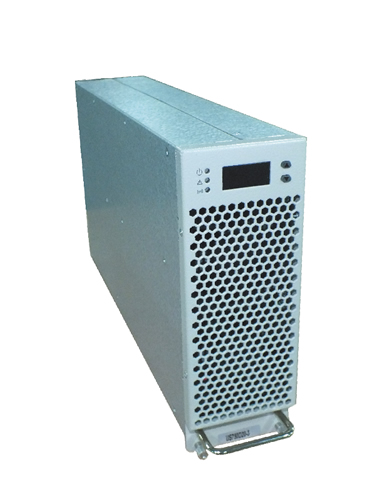
- Details
Modular Explain
The charging module is designed with the world's leading power technology and technology, which is specially designed for the power conversion equipment charged by electric vehicles. Has the characteristics of active power factor correction, high efficiency, high power density, high reliability, intelligent control and beautiful appearance; cooling module adopts intelligent air-cooled, high power density, small occupied space; with hot plug and reverse battery protection function, simple screen group.Working principle
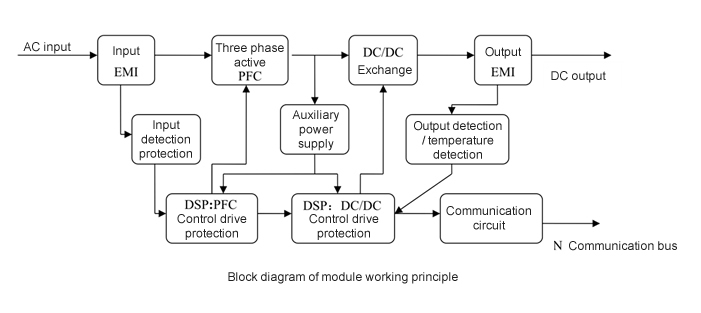
The charging module is composed of three phase active PFC, DC/DC transform, auxiliary power supply, input and output detection and protection circuit. The three-phase active PFC circuit and EMI circuit to realize input rectifier filter and power factor correction AC input, in order to meet the EMC standard and the total harmonic content of the current is less than 5% (THDi); three phase active PFC was controlled by a single DSP, according to the AC input voltage, the input current is corrected to follow the AC input voltage loop, and in accordance with the calculation results to produce PWM wave to drive the main circuit, and the implementation of relevant protective measures; DC/DC converter level generated by the DSP wave PWM control PFC stage output DC voltage, high frequency transformer output after after rectifying and filtering the output current and voltage to stable DC voltage before the rectifier voltage into the charging module requirements.
The auxiliary power supply uses the DC output of the three-phase active PFC to produce all the power supply for the control circuit. The input detection circuit realizes the detection function of AC input voltage, current and so on, which is used for the control and protection of PFC. The detection and protection circuit of DC/DC includes the detection of the output voltage and current, the detection of temperature, and so on. These signals are used for the control and protection of DC/DC.
The CAN/485 bus realizes the communication between the rectifier module and the control module and the current sharing between the multiple rectifying modules.